

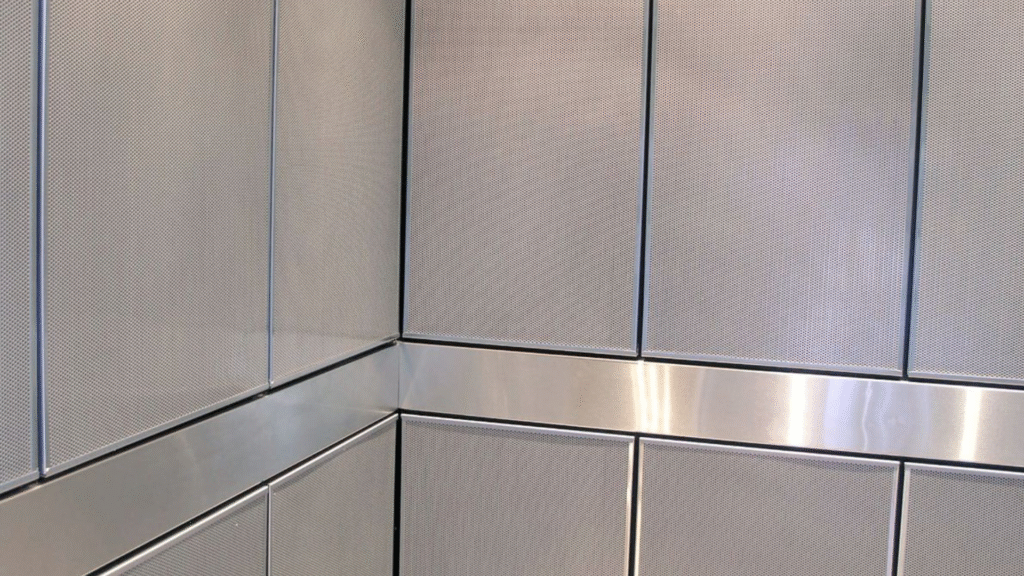
Elevator interior renovation has evolved significantly over the past decade. For years, architectural vinyl film was widely positioned as the go-to solution for elevator refinishing. However, after analyzing multiple multifamily and hospitality projects, a new question began to surface:
Is vinyl film always the most efficient and strategic solution for elevator interiors?
Through hands-on experience in high-traffic buildings, we evaluated the real-world performance of two common surface solutions:
- Architectural vinyl film
- Laminate peel-and-stick systems for flat panels
This article breaks down the technical differences, performance factors, installation realities, and long-term strategic implications of vinyl film vs laminate for elevator panels, particularly in multifamily and hospitality environments.
Understanding Architectural Vinyl Film
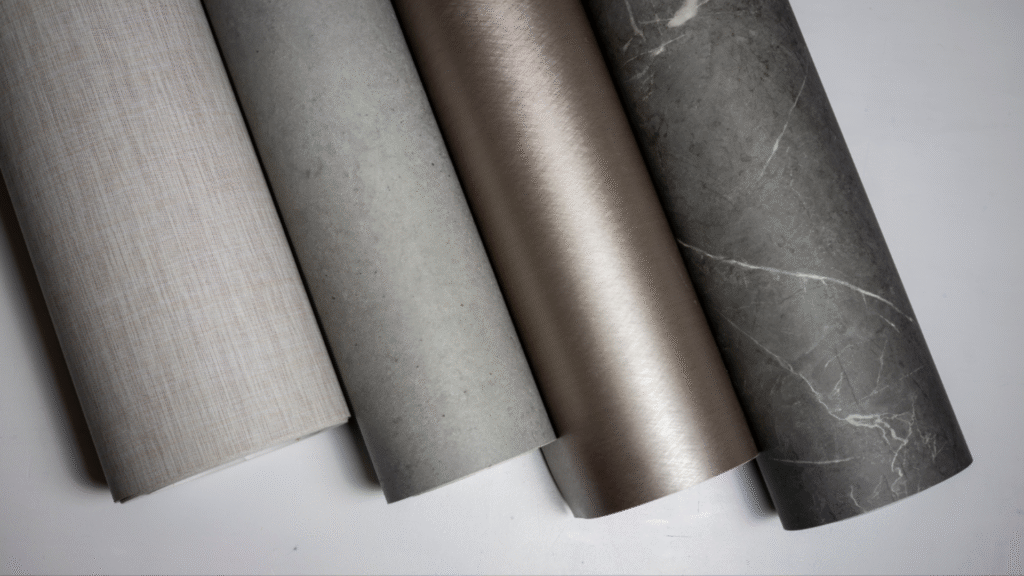
Architectural vinyl film is typically a PVC-based surface material designed to simulate finishes such as wood, stone, metal, or solid colors. It is engineered for architectural surface renewal and is commonly used in:
- Elevators
- Doors
- Cabinetry
- Wall panels
- Retail interiors
According to 3M Architectural Finishes, architectural films are designed to conform to complex surfaces and curves, allowing application on doors, frames, and contoured elements.
This flexibility is one of its primary advantages.
Advantages of Vinyl Film in Elevator Renovation
Architectural vinyl film offers:
- High conformability
- Ability to wrap curved surfaces
- Application on doors and frames
- Premium finish simulation
- Design versatility
It is often selected when the goal is full elevator refinishing, including doors, returns, and detailed architectural elements.
However, during project execution, performance must be evaluated beyond product marketing.
What We Observed in Real Elevator Projects
Across multiple multifamily elevator renovation projects, one consistent pattern emerged:
The majority of visible wear occurred on flat interior panels, not doors or curved surfaces.
In high-traffic buildings:
- Luggage carts impact side panels
- Move-ins and move-outs scrape flat walls
- Service activity damages interior panel surfaces
Very rarely were elevator doors the primary aesthetic issue.
This insight shifted the material conversation.
Understanding Laminate Peel-and-Stick Systems
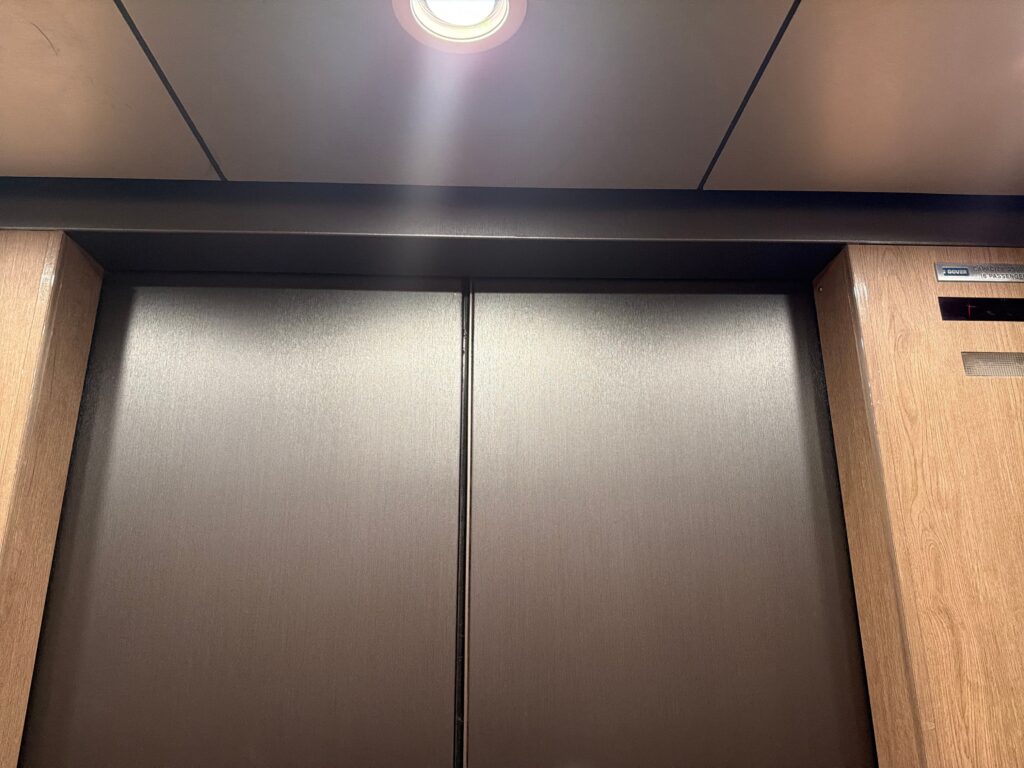
Laminate peel-and-stick systems are engineered primarily for flat surface applications. Unlike conformable vinyl film, laminate systems:
- Are thicker
- Are more rigid
- Are optimized for flat panels
- Are not intended for curved or complex surfaces
Because of this, they are particularly suited for flat elevator interior panels.
Laminate technology has been widely used in cabinetry, millwork, and high-durability environments for decades.
According to Wilsonart, laminate surfaces are known for abrasion resistance and durability in high-traffic commercial interiors.
Vinyl Film vs Laminate for Elevator Panels: Technical Comparison
| Feature | Architectural Vinyl Film | Laminate Peel & Stick |
| Surface Type | Flexible PVC | Rigid laminate |
| Conformability | High | Low |
| Curves & Doors | Yes | No |
| Flat Panels | Yes | Yes (optimized) |
| Thickness | Thin | Thicker |
| Impact Resistance | Moderate | Higher (flat surfaces) |
| Install Complexity | Higher | Lower |
| Risk Level | Moderate to High | Lower (flat only) |
| Scalability | Moderate | High |
Installation Complexity Matters More Than Marketing
One of the most underestimated factors in elevator interior renovation is installation risk.
Vinyl film requires:
- Skilled installers
- Heat forming for curves
- Precision around edges
- Higher margin for error
Laminate peel-and-stick systems for flat panels:
- Require less conforming skill
- Have lower installation variability
- Are faster to apply on flat surfaces
- Reduce potential callbacks
When working in occupied multifamily buildings or hotels, reducing complexity directly impacts:
- Downtime
- Tenant disruption
- Project predictability
Durability in High-Traffic Elevator Environments
Elevators are not decorative spaces, they are high-impact zones.
According to the National Association of Elevator Contractors (NAEC), elevator interiors are among the most frequently used architectural spaces in vertical residential buildings.
In multifamily and hospitality environments, panels endure:
- Constant cart impact
- Cleaning chemicals
- Abrasion
- Repetitive contact
Thicker laminate surfaces on flat panels often demonstrate stronger impact resistance compared to thin flexible films when applied strictly to flat surfaces.
This does not mean vinyl film lacks durability. It means:
Material selection should align with the actual surface type and wear pattern.
Strategic Insight: Where Most Elevator Wear Actually Happens
After analyzing multiple projects, including multifamily properties in high-traffic urban markets, a clear trend became visible:
- 80% of aesthetic wear occurred on interior flat panels
- Doors were less frequently damaged
- Curved surfaces were rarely the primary issue
This led to a strategic refinement:
Rather than offering full elevator refinishing, focusing on flat-panel renewal delivers:
- Faster execution
- Lower risk
- Lower cost
- Higher scalability
- Reduced disruption
ESG and Sustainability Considerations
Extending the life of existing elevator interiors aligns with sustainability goals.
The World Green Building Council highlights that extending asset life significantly reduces embodied carbon by minimizing demolition and material replacement.
Both vinyl film and laminate systems contribute to:
- Reduced waste
- Surface reuse
- Lifecycle extension
However, choosing a material optimized for the surface type reduces premature failure and repeat interventions, which further improves sustainability outcomes.
Cost Efficiency and Lifecycle Strategy
From a financial standpoint, multifamily and hotel asset managers are not looking for permanent perfection.
They are looking for:
- Predictable lifecycle management
- Controlled capital allocation
- Phased renovation strategies
Flat-panel laminate solutions often provide:
- Faster turnaround
- Lower labor intensity
- Reduced technical risk
- 3-5+ year lifecycle extension (depending on traffic conditions)
That aligns well with phased capital planning.
GEO Considerations: North American Market
In North America, elevator renovation projects are increasingly driven by:
- Budget control
- Occupied building constraints
- Labor cost inflation
- Demand for faster project execution
According to the U.S. Bureau of Labor Statistics, construction labor costs have risen significantly over recent years, increasing pressure to simplify scope.
Reducing complexity through flat-panel-focused solutions directly responds to these market pressures.
So Which Is Better: Vinyl Film or Laminate?
The correct answer is not universal.
Vinyl architectural film is ideal when:
- Full elevator refinishing is required
- Doors and curves must be wrapped
- High design flexibility is needed
Laminate peel-and-stick systems are ideal when:
- Only flat panels are worn
- Speed and predictability matter
- Buildings are occupied
- Risk minimization is critical
The key insight from real projects is this:
Material should follow a wear pattern, not marketing narrative.
Final Strategic Conclusion
The evolution from broad architectural film refinishing to targeted flat-panel laminate solutions is not a downgrade.
It is a refinement.
After analyzing multiple elevator projects, the data consistently showed:
- Flat panels take the most abuse
- Simpler scope reduces risk
- Targeted solutions scale better
- Predictability increases ROI
Elevator interior renewal is not about doing more. It is about doing what matters most, better.
If you are evaluating vinyl film vs laminate for elevator panels in your multifamily or hotel property, the decision should be based on surface type, traffic level, and operational constraints, not just design preference.
Explore how targeted flat-panel elevator renewal strategies can reduce disruption, control costs, and extend lifecycle predictably.
Talk to our team to learn more about material selection strategies for high-traffic buildings.